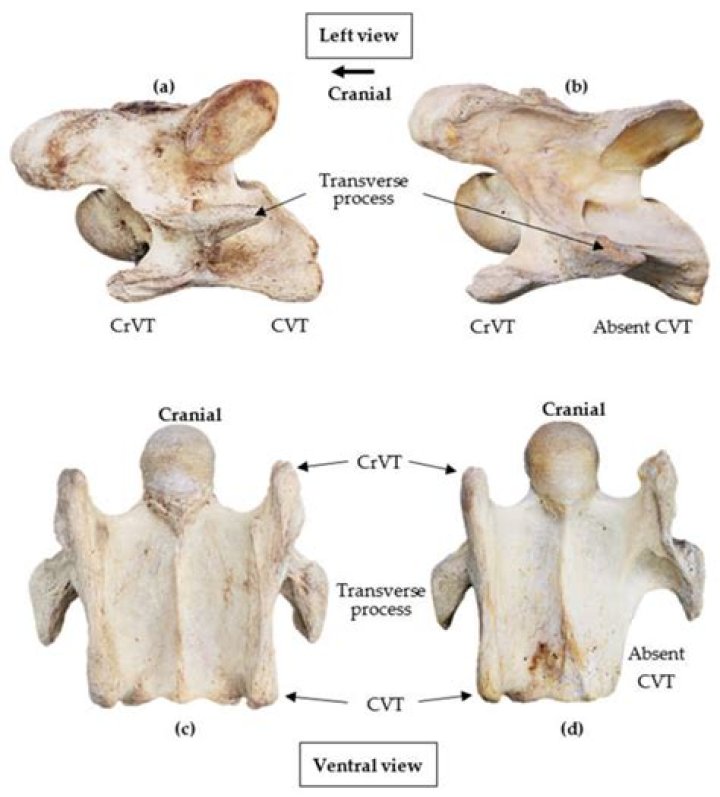
Cervical Vertebrae. There are seven cervical vertebrae in the human body. They have three main distinguishing features: Bifid spinous process – the spinous process bifurcates at its distal end. Exceptions to this are C1 (no spinous process) and C7 (spinous process is longer than that of C2-C6 and may not bifurcate)..
Furthermore, how are cervical vertebrae different?
Lower Cervical Spine. The 5 cervical vertebrae that make up the lower cervical spine, C3-C7, are similar to each other but very different from C1 and C2. Each has a vertebral body that is concave on its superior surface and convex on its inferior surface (see the image below).
Also Know, why is it called cervical vertebrae? Medical Definition of C1-C7 (cervical vertebrae) It supports the head and is named for the Greek god Atlas who was condemned to support the earth and its heavens on his shoulders. (Because the god Atlas often adorned maps, a compilation of maps came to be known as an atlas).
Regarding this, what is the cervical vertebrae function?
The vertebrae that make up the cervical spine are the smallest seven within the spinal column. These bones give the neck structure, support the skull, and protect the spinal cord, among other functions. This is where ligaments and muscles attach to the vertebra. The bodies of the vertebrae are connected to one another.
Which cervical vertebrae is most prominent?
Unique Vertebra: C7 The seventh cervical vertebra, also called the vertebra prominens, is commonly considered a unique vertebra and has the most prominent spinous process.
Related Question Answers
What nerves are affected by c2 and c3?
C1, C2, and C3 (the first three cervical nerves) help control the head and neck, including movements forward, backward, and to the sides. The C2 dermatome handles sensation for the upper part of the head, and the C3 dermatome covers the side of the face and back of the head.What does c6 7 control?
The C7 myotome is a group of muscles controlled by the C7 nerve. These muscles include those involved in straightening the elbow, lifting the wrist, elongating the fingers to an outstretched hand, and the triceps muscle in the upper arm.Where does most cervical rotation occur?
The movement rotating the head left and right happens almost entirely at the joint between the atlas and the axis, the atlanto-axial joint. A small amount of rotation of the vertebral column itself contributes to the movement.What two features do cervical vertebrae have?
The main anatomical characteristics of a typical cervical vertebra that separate it from other types of vertebrae are the small size, transverse foramina, saddle-shaped body, and bifid spinous process (Fig. 1.7.Where is the c5 c6 vertebrae located?
The C5-C6 spinal motion segment (located in the lower cervical spine just above the C7 vertebra) provides flexibility and support to much of the neck and the head above.What does the c2 vertebra control?
The C2 vertebra is the axis which the C1 vertebra pivots around and lets us move our skulls from side to side in a horizontal motion. Like the C1 vertebra, a C2 vertebra has a greater degree of motion than other vertebrae that are lower on the spinal column.How many joints are in the cervical spine?
There are two joints unique to the cervical spine – the atlanto-axial (x3) and atlanto-occipital joints (x2).What is the dens in the cervical spine?
Odontoid process (Dens) This is a rostral, or upwards extension from the body of the Axis (C2, Second cervical vertebral body). It serves as a point of rotation of Atlas (C1, First cervical vertebral body) and the Axis (C2, Second cervical vertebral body).What does cervical mean when talking about the spine?
Cervical Spine Definition. The cervical spine, also known as the neck, is comprised of seven vertebral bodies (C1-C7) that make up the upper most part of the spine. These vertebrae connect the spine to the skull.What are the seven vertebrae in the neck called?
Overview. These are the seven bones of the neck, called the cervical vertebra. The top bone, seen on the right of this picture, is called the atlas, and is where the head attaches to the neck. The second bone is called the axis, upon which the head and atlas rotate.What causes c2 misalignment?
The atlanto-axial joint allows for healthy rotation in your neck, but it can cause the C1 and C2 to become misaligned when it's affected by RA. Misalignment and instability can impinge your spinal cord, brainstem and/or other nerves, which can cause pain and other serious neurological symptoms.What are the functions of the neck?
The neck supports the weight of the head and protects the nerves that carry sensory and motor information from the brain down to the rest of the body. In addition, the neck is highly flexible and allows the head to turn and flex in all directions.How far down does cervical spine go?
The cervical spine is made up of the first seven vertebrae in the spine. It starts just below the skull and ends just above the thoracic spine. The cervical spine has a lordotic curve (a backward C-shape) - just like the lumbar spine.What are the vertebrae in your neck?
There are seven vertebrae within the cervical spine. They are numbered C1 to C7, from top to bottom. The first two vertebrae of the cervical spine are specialized to allow for neck movement. C1, also called the atlas, sits between the skull and the rest of the spine.Where is cervical located?
The cervical spine consists of seven vertebrae and is located at the base of the skull. Its function is to support the skull, enabling head movements back and forth, and from side to side, as well as protecting the spinal cord.Where is the cervical region?
The cervical spine, or neck, begins at the base of the skull and through a series of seven vertebral segments connects to the thoracic, or chest, region of the spine.How many cervical nerves are there?
There are eight pairs of cervical nerves, twelve pairs of thoracic nerves, five pairs of lumbar nerves, five pairs of sacral nerves, and one pair of coccygeal nerves. The spinal nerves are part of the peripheral nervous system.What does cervical mean in medical terms?
Cervical has multiple meanings in the human body. The word cervix is derived from the Latin root word "cervix" which means "neck." For this reason, the word cervical pertains to many areas where tissues narrow to a neck-like passage, and not only in your neck.What is the medical term for cervix?
Medical Definition of Cervix Cervix: The cervix is the lower, narrow part of the uterus (womb). The uterus, a hollow, pear-shaped organ, is located in a woman's lower abdomen, between the bladder and the rectum. The cervix forms a canal that opens into the vagina, which leads to the outside of the body.